My thoughts on watercolour
painting ‘wet-in-wet’
September 2026
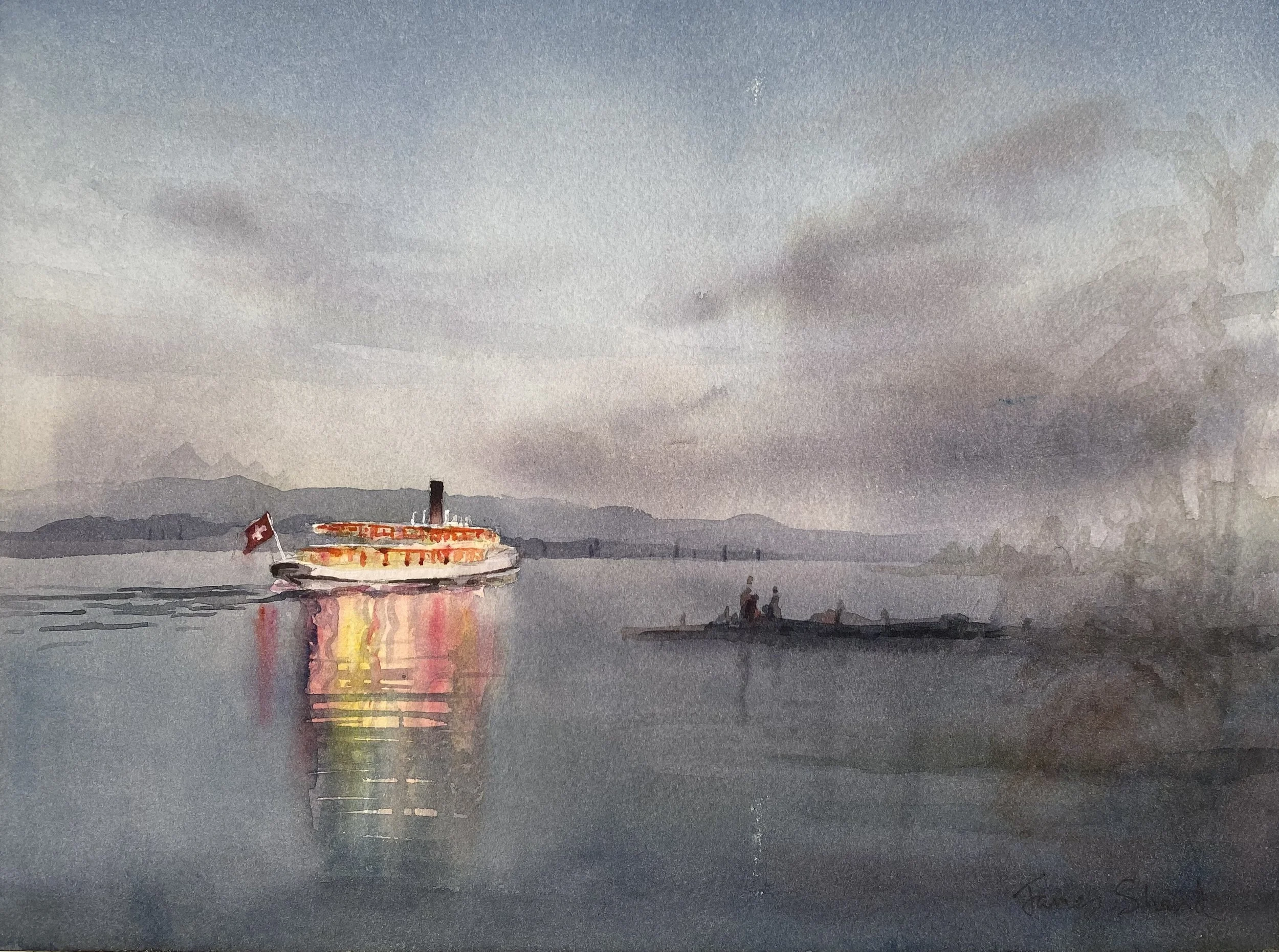
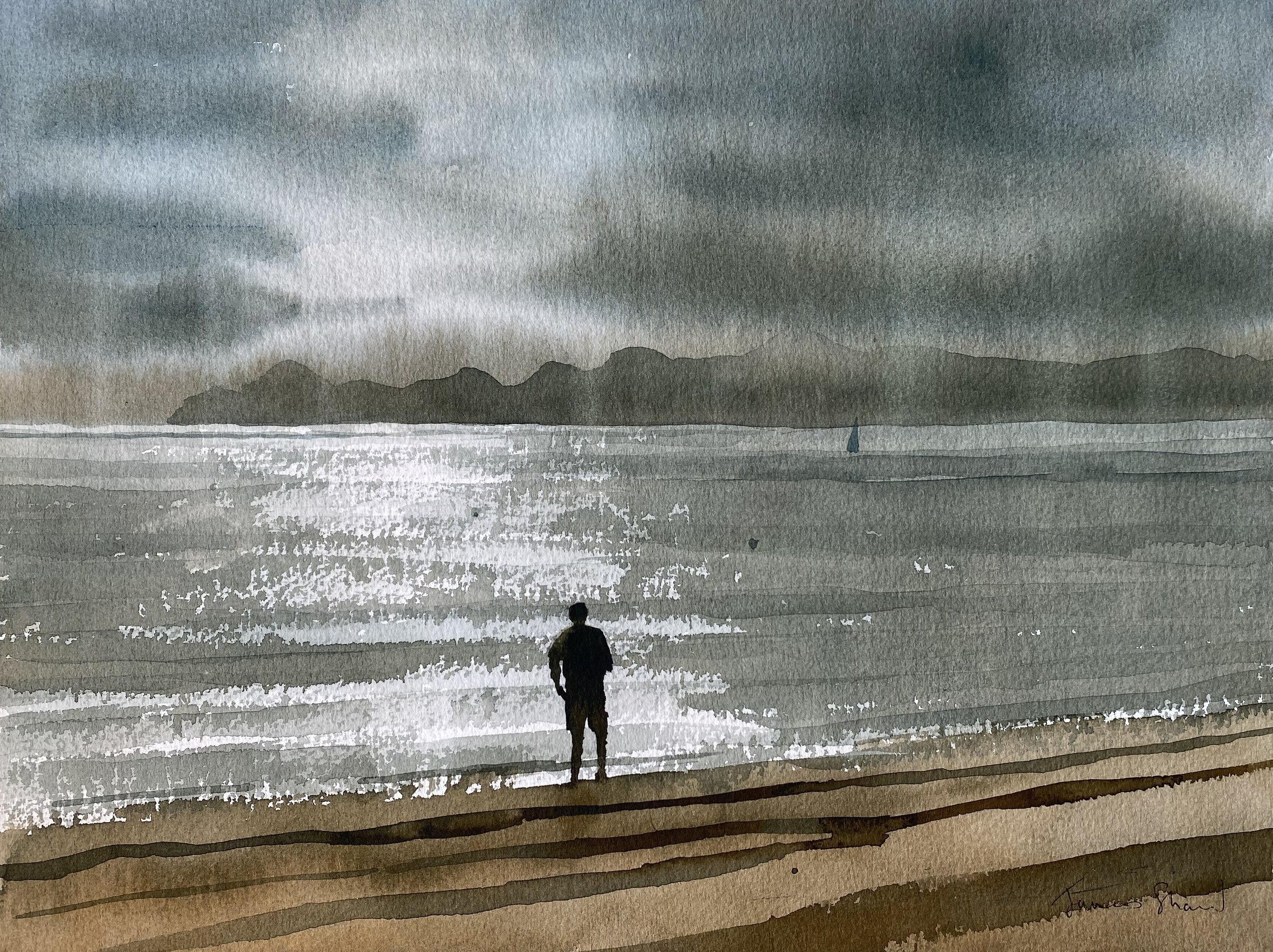
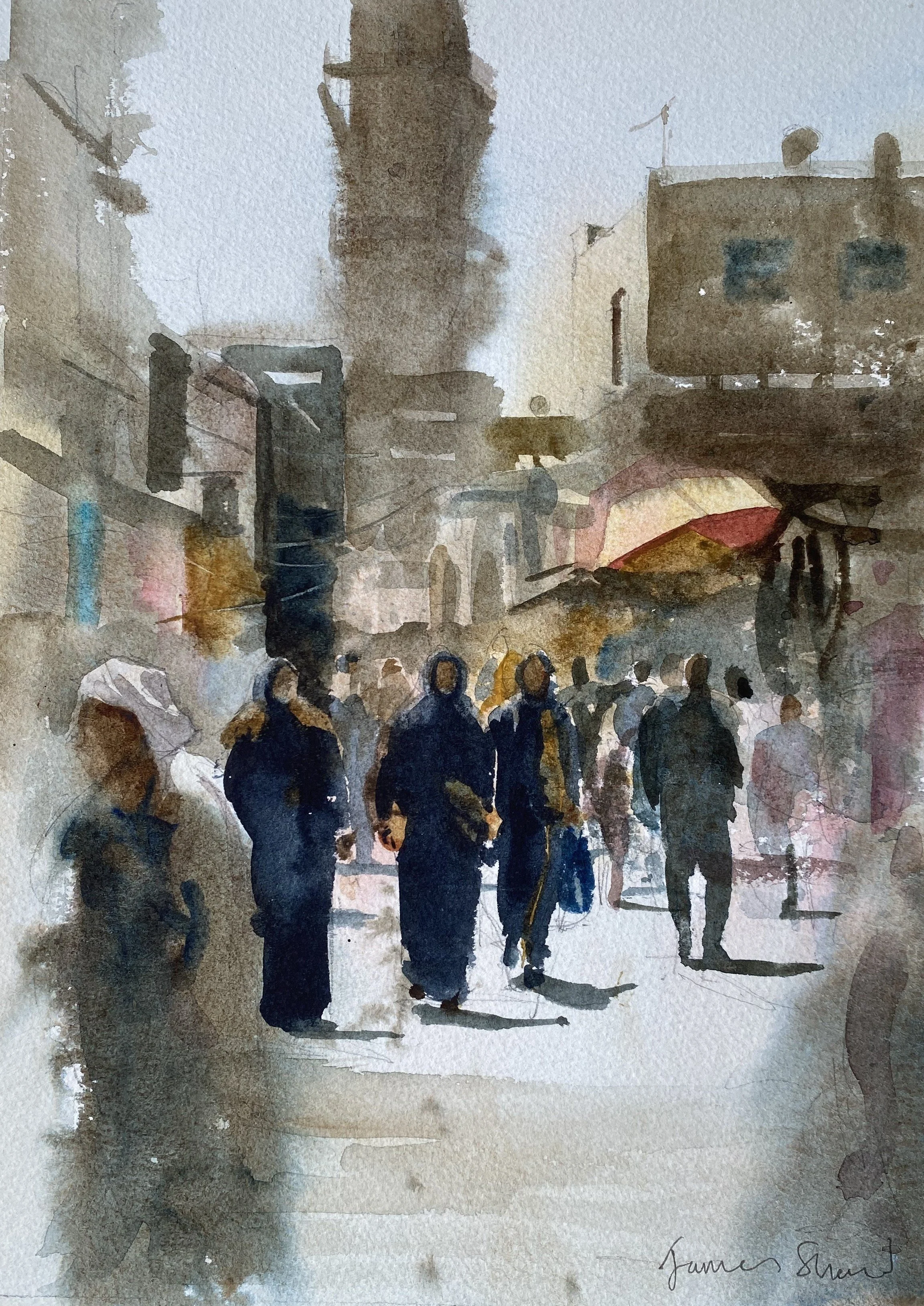
Demonstration of dropping washes into wet paint to create soft edges, using a classic mix of burnt sienna and French ultramarine. The subject is an imagined sky and seascape.
Here are some of my paintings which have an element of this technique:
the thumbnail sketch
August 2026
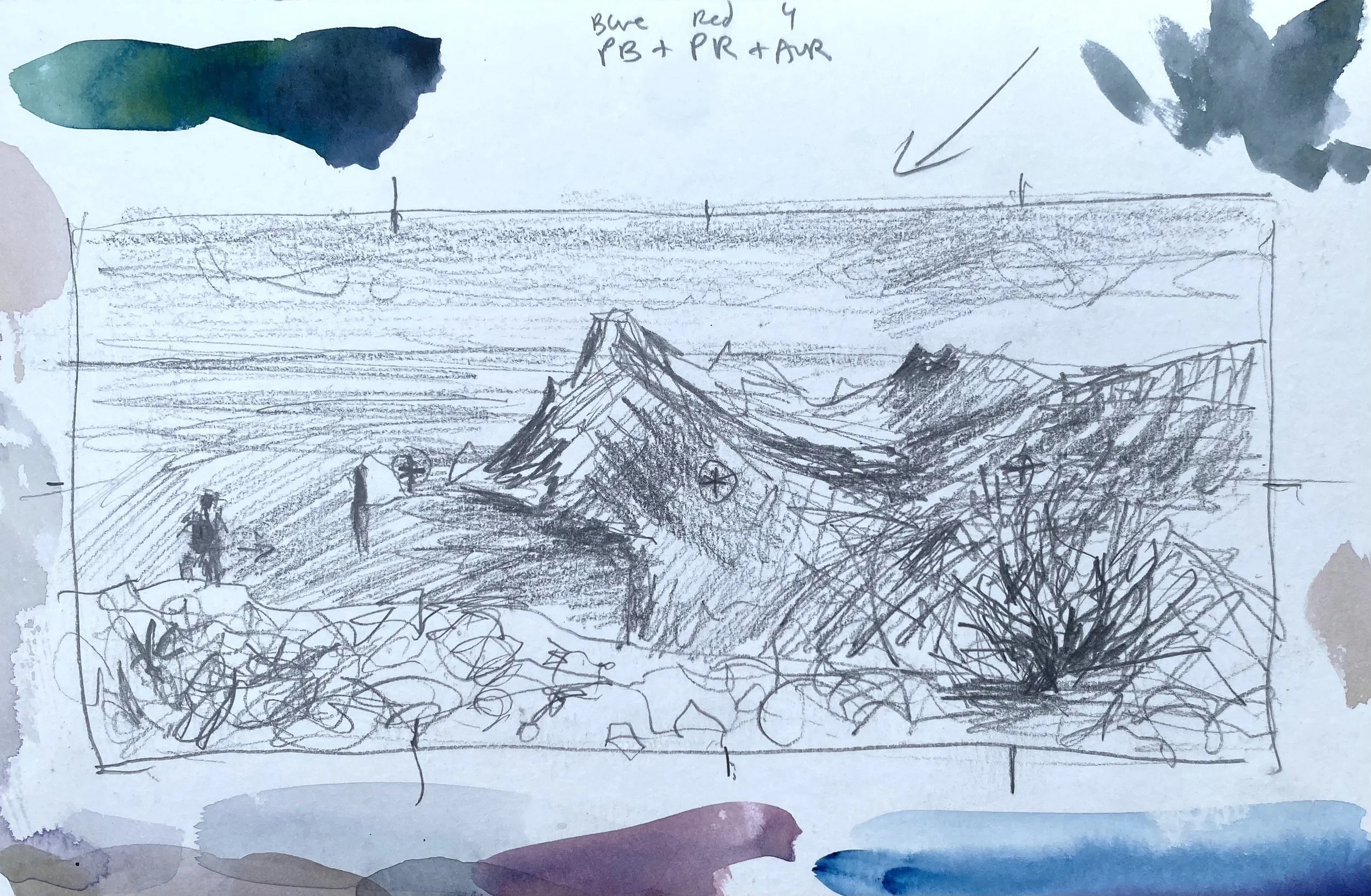
Before attacking the blank sheet of watercolour paper, it is often worthwhile spending a few minutes making what we call a thumbnail sketch. This small, simple drawing may seem like an unnecessary extra step, but a thumbnail sketch allows me to explore the arrangement of shapes, tones, and potential focal points before committing to the main painting.
The subject you are painting is usually packed with detail. Whether it is a bustling street scene, or a quiet landscape, there is far more information than can or should be included in the finished painting. So one of the artist's most important tasks is to decide what to leave out. A successful watercolour is not a complete record of everything that was seen. Instead, it guides the viewer's eye towards one or two key elements within the composition. This might be a solitary figure, a brightly lit window, the silhouette of a tree (tall cypresses are eye-catching), or simply a striking contrast between light and shadow. Everything else should play a supporting role.
The thumbnail sketch provides an opportunity to identify these dominant features. By reducing the scene to a few simple shapes and tonal masses, you can judge whether the composition has a clear centre of interest and whether the balance of darks and lights creates a pleasing visual path through the picture. Because the sketch is small and quick, it encourages experimentation. I can try several alternative arrangements in only a few minutes, allowing the strongest composition to emerge.
This planning is especially valuable in watercolour. Unlike many other painting media, watercolour rewards confidence and decisiveness. Much of its beauty comes from the natural movement of pigment suspended in water, flowing and settling across the paper in ways that cannot be entirely controlled. To preserve these fresh, luminous effects, a watercolour is often painted rapidly, with relatively few corrections. There is little opportunity to stop halfway through and rethink the composition, and it is all too easy to make mistakes. They cannot be painted over (as they can with oil painting).
For this reason, the thumbnail sketch becomes an essential guide. It provides a clear guide that allows me to paint with confidence, knowing where the focal point belongs, how the main shapes and edges relate to one another, and where the strongest contrasts should be placed. With these decisions already made, my attention can be devoted to handling the paint.
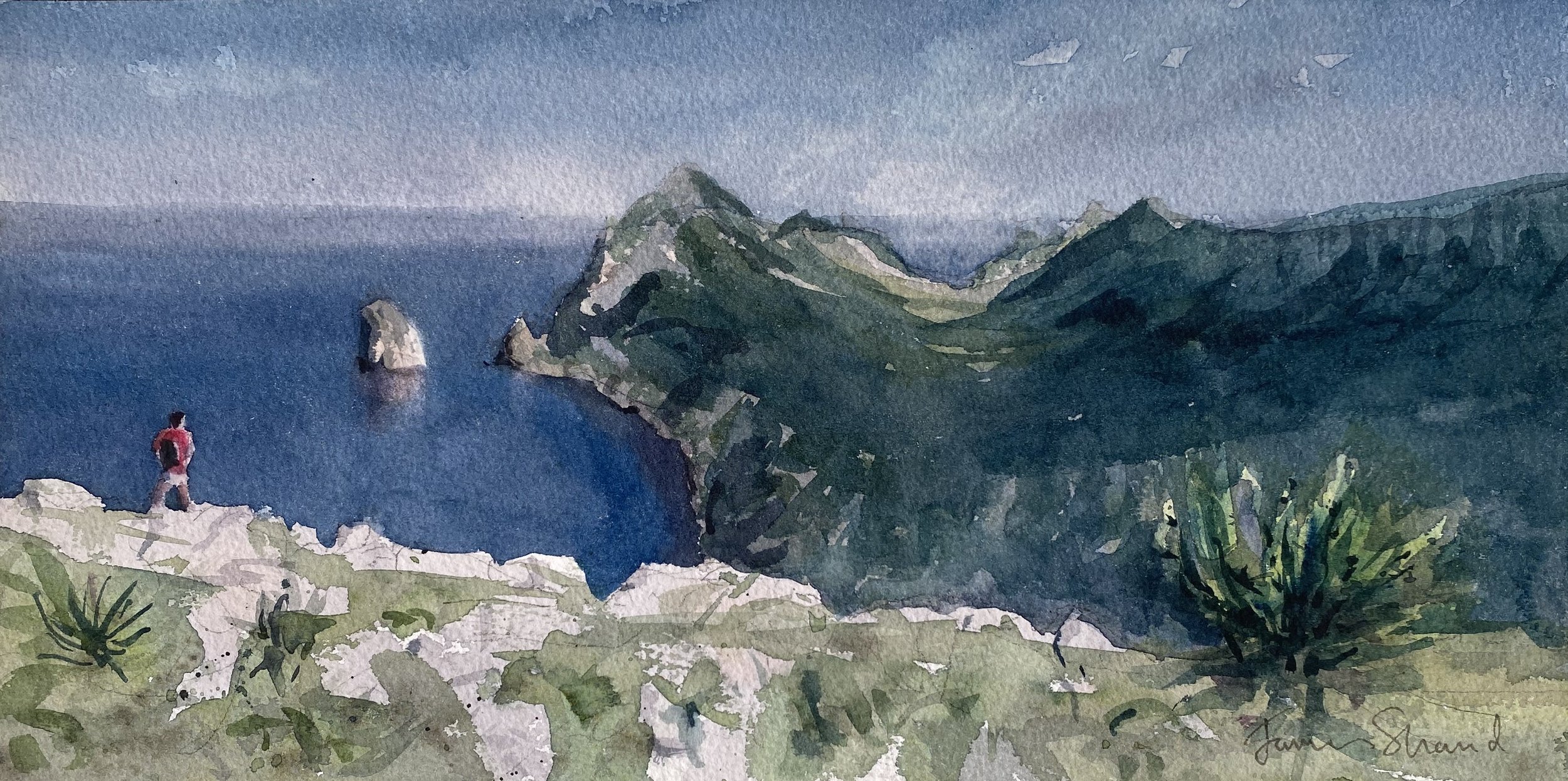
In the pictured thumbnail sketch (for the painting Towards Cap Formentor, Mallorca), I have also added an arrow to remind me from which the direction the light is coming, marker points around the edge and across the middle which are transferred to the finished painting to guide the initial drawing, as well as notes on colours (Prussian Blue, Permanent Rose, Aureolin) and colour testing.
my sketchbooks
July 2026
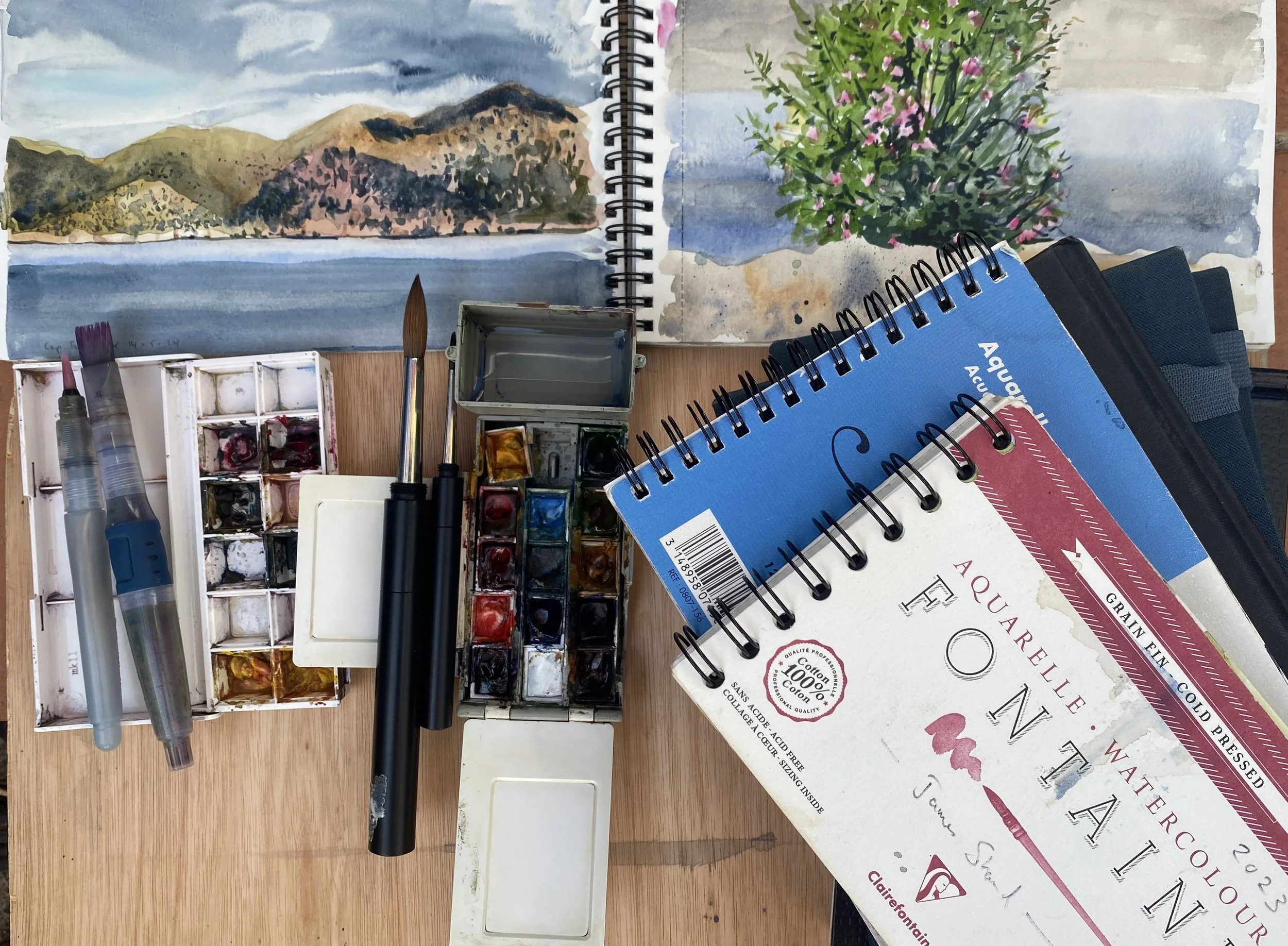
While I devote much of my time to creating the larger finished watercolours on this website, painting and drawing in sketchbooks form an equally important part of my practice. One of these sketchbooks is shown in a short video on the About the artist page, offering an insight into this more spontaneous side of my work.
Sketchbooks have practical advantages as well as artistic ones. They are light enough to carry almost anywhere and require very little equipment. Unlike larger paintings, they do not need an easel or a carefully prepared working space. If I cannot find somewhere comfortable to sit, I simply paint standing up, balancing sketchbook and palette in one hand while holding my brushes in the other. It is every bit as awkward as it sounds, but it allows me to work wherever a scene captures my attention rather than only where conditions are ideal.
The sketchbook is an essential companion when I travel, particularly on shorter time-limited trips. Over the years I have experimented with different combinations of materials to make painting on location as convenient as possible. Sometimes I use a compact folding palette with fourteen half-pans of colour; at other times I travel with an even smaller palette containing only the three primary colours, relying on colour mixing to create the full range of hues. I have also tried different brushes. Waterbrushes, which hold water in the handle, are undeniably practical, although their synthetic bristles do not retain as much paint as I would like. Folding travel brushes, which unscrew and fold neatly into themselves, are less compact but have high-quality natural hair that holds both water and pigment far more effectively.
Back home, these sketchbooks become a valuable record of my experiences. Together with photographs, they provide the starting point for a series of larger, more considered paintings. My finished works are not intended as copies of the sketches but as collections of memories that aim to convey the essential character of a place - its light, atmosphere, colours, textures, and details.
Above all, however, the sketchbook is a place of freedom. It allows me to paint without the expectation of producing a finished artwork. I can work quickly, respond instinctively, and occasionally experiment with ideas, compositions, or techniques that I might not otherwise attempt. For example, the approach known as sprezzatura, which involves loose, vigorous and apparently effortless brushwork. Painting directly from life, or en plein air as we say, is an absorbing and deeply relaxing experience. And when a sketch works, it is a thrill.